
Why Quality?
Why Quality? It is a simple two-word question. Should be a snap-to answer, but is it? People like Deming, Juran, and Crosby all have made a play for defining what quality is, but no one has dived deep into why the quality of a product is so important to the end-user. From the beginning of the first goods traded or bartered, whether a bracelet, shell, or food, the concept of quality has existed. How is it that the quality of a product is so instinctually present? What are the psychological drivers innate within people? And of course, why is quality so important to the success of the brand?
Over the next few posts, I would like to share my learnings regarding “quality” and how brand loyalty only exists when the consumers perceive quality within a product.
Not convinced? Let’s do a small mental exercise.
Below are mentioned brands, when comparing which instantly comes to mind as higher quality? Okay, Ready, Go! –
- Nike versus Converse
- Mercedes versus Kia
- Apple Computers versus Acer Computers
- Samsung TVs versus Insignia TVs
Were some an easy comparison? If 100 people were polled, there could very well be an overwhelming high selection for certain brands, even without a single statistic that proves one brand's quality is better than the other. Such statistics represent factors such as failure rates, actual claim performance, customer complaints, reliability, and availability. People who work in marketing would say that this is because of a good marketing plan, but in today’s social world, if there wasn’t something else, the brand would be exposed very quickly, and sales would plummet. Therefore, in addition to great marketing, consistency in quality can help create a long-term loyal customer base.
Looking at how a customer perceives quality innately, especially in food products can help to answer the question of Why Quality?
Thinking about the example above, there is an inherent bond of trust between the supplier and the consumer. These trust factors lead to the consumer either becoming loyal to the brand or never wanting to buy those things again. While there are no hard rules, concepts can be generalized into factors that affect brand loyalty.
Morals
When a supplier provides a food product, the consumer expects the provider to have a sense of morality. With that sense of morality, there is an inherent trust formed between the supplier and the consumer when they accomplish a few pieces critical to quality.
- The product is Food-Safe
- The product is legal
- The product is as intended
Notice Food-Safe is listed first as it is the number one thing that people put their inherent trust in, and without a food safe product, goods will never be referred to as a high-quality product. Food safety is expected; no one purchases food products with the intent that they may be toxic or cause harm to when consumed. There are U.S. laws around the production of food and pet food products, but recalls are still current in the media. When a recall happens, the first thing on a consumer’s mind is that they’re not buying that product again. The bond of trust is broken. So, food safety, above all, is critical.
The second is the product must be legal. No consumer is expecting to get raided by the police because they bought a food product at a retail outlet or online. It is expected that the manufacture is licensed to do business for the sale of food and has done their due diligence to be in good standing with all local, state, and federal regulations. The consumer generally does not even know what those are, but they inherently trust that it is being done.
Finally, they expect the product to be as intended; for example, when buying cookies, the box shouldn’t contain a shake. If it’s fully cooked, then the product shouldn’t be raw. Think of this as the old bait and switch; when purchasing a house or a car and the photos portraying the product don’t match what was physically seen in the house or car? A sense of betrayal can arise. Same thing happens with food products when a consumer doesn’t get what they intended.
Ethics
The next inherent trait that consumers perceive are traits involving the ethics of the food products. Ethically, consumers expect that the manufacturer wants to do the following:
- To provide a consistent product
- For the consumer to have a pleasant experience with the product
- To provide product integrity
Often, as part of the definition of quality, the word consistent follows. Consumers relate consistency with high quality. They expect food to look and taste the same each time they purchase it; and when there is something different without disclosure, they look at this as questionable. This often occurs when a manufacturer changes an ingredient or supplier, but the consumers may say, “it doesn’t taste like it used to”. When these events occur, the trust bond is broken, and consumers may start looking for alternatives. Consumers want to have a pleasant experience with the product. This happens on so many levels. From the cooking instructions, to how easily the package is opened, or whether it seals. Consumers want to have a pleasant experience. They feel like that is owed to them because they gave the company their dollar at the checkout aisle.
Socioeconomics
A final inherent driver with quality is of a socioeconomics nature. These are the “feel good” emotions around buying a certain product group. It is well known that certain food products will inherently cost more, just because of the product’s nature. For example, an increase in price may be expected when purchasing organic products. Furthermore, if the products are part of the sustainable product initiative, the same may be expected. In general, people are often driven by doing the “right thing”, and part of a company’s quality nature is to be considerate of socioeconomic drivers. Overall, it brings loyalty, trust, and prestige to the brand. Those brands that consumers feel a sense of pride in when buying are always associated with higher quality.
Total Quality
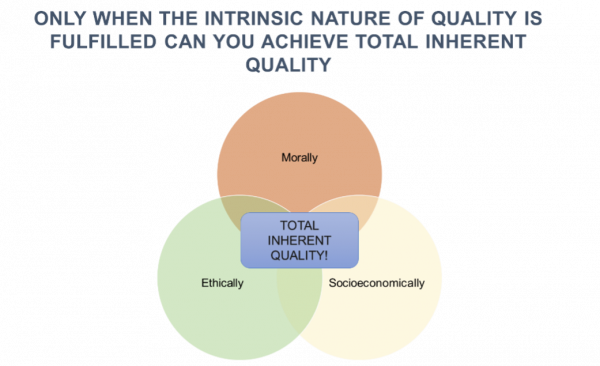
The basic building blocks of inherent quality will more often be stressors against the other blocks. The term “continuous improvement” is essentially the point at which all the stressors are in balance. It is only within that overlapping area where the different blocks are in balance, “Total Quality” is achieved. The reason why improvement is continuous is because of all the variables constantly changing during a product’s lifecycle.
Wrapping this segment up, from the beginning people have inherently conceptualized the quality of produced goods. Quality becomes a consumer issue at a much deeper, physical level. Consumers will only believe a product is of high quality when their moral, ethical, and socioeconomic needs have been met. The needs build the blocks of trust and brand loyalty, which are so important where fierce competition exists.
Next Time: Why Quality? Part 2 – Why total quality is essential to the brand and who’s responsible for this quality stuff anyway...
Follow us on LinkedIn for the latest updates on all things happening here at BSM Partners.
About the Author
August Konie has been a Food Safety, Quality and Regulatory Professional for over 30 years. He was worked in many sectors of the food industry including fisheries, beverages, poultry, pork and pet food, under both FDA and USDA regulatory oversight. As an active committee member in various trade organization for food and pet food organizations, he was successful of implementing new regulatory guidance. He has worked with various teams across Asian, Europe, North and South American on various food safety, quality and import/export concerns. He currently serves as the Principal of BSM Assurance overseeing FSQAR activities at BSM Partners.
This content is the property of BSM Partners. Reproduction or retransmission or repurposing of any portion of this content is expressly prohibited without the approval of BSM Partners and is governed by the terms and conditions explained here.