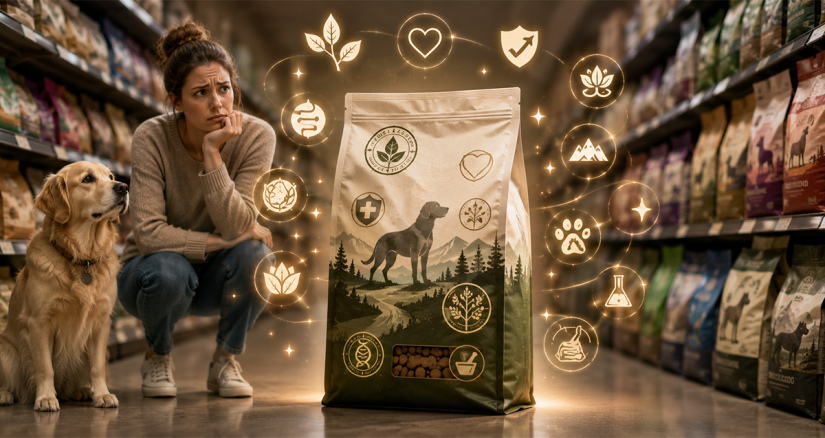
What’s in a Claim? 3 Marketing Buzzwords That Say Virtually Nothing About Your Pets’ Food
Sometimes products make promises they can’t fully keep. Actually, this happens often. It’s not always false advertising; every rule has an exception, and something marketed for mass appeal is bound to disappoint someone at some point. But when brands lean so heavily on marketing terms that they confuse or mislead consumers, the strategy starts to feel more nefarious.
This point becomes even more poignant when dealing with pet food and supplements—products we, as humans, purchase on behalf of our pets without any real insight into the end consumer.
The pet supplement market, where claims can overpromise and underdeliver for a multitude of reasons, is a microcosm for confusion around pet nutrition claims in general. As my colleague, Kait Wright, put it in “From Paint to Pet Food: Understanding the Truth Behind Marketing Claims,” product claims are “supposed to make it easier for consumers to understand what they [the products] purport to do, but confusion comes when these marketing gimmicks lead people to draw conclusions that aren’t factual.”
There are a handful of commonly used pet nutrition marketing claims with more bark than bite, but let’s focus on three of my favorites: clean-label, minimally processed, and holistic.
‘Clean Label’
We see this one across the food and beverage space, not just in pet nutrition. By design, a “clean label” claim is meant to signal a product is superior because it is cleaner in principle—not contaminated, adulterated, “dirty,” or insert synonym here. As consumers, we are influenced by our preferences for hygiene, transparency, and ultimately safety. In pet, it also plays on our guilt. Why would you knowingly give your beloved pet, who trusts you more than anyone, anything less?
The fact of the matter is, “clean label” means something different to each of us. If you share living quarters with another human being, dare I assume you’ll understand what I mean. Even my dog and I fundamentally disagree on what’s “clean.” He loves getting muddy, loathes baths, and sees no problem with peeing on his stuffed giraffe toy and then carrying it around in his mouth. You get the idea. If he could read and shop for himself, I guarantee he would not be impressed with a “clean label” claim. In fact, he’d probably go for something more like “authentic carcass stench,” and your dog probably would, too.
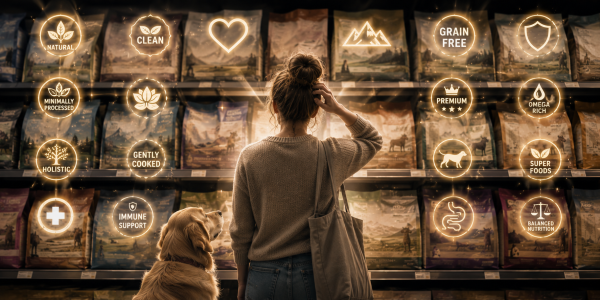
Photo by ChatGPT
‘Minimally Processed’
Many newer pet food formats, such as fresh, freeze-dried, and air-dried, tout “minimally processed” or “gently cooked” claims to indicate the product hasn’t undergone as harsh a cooking process as dry extruded or canned pet food. However, these claims are nebulous at best.
My colleague, Dr. Sydney McCauley, has written extensively on this. The issue is similar to clean-label claims. “Minimally processed” and “gently cooked” imply to pet parents that processing is inherently harmful, but that’s a gross generalization. Processing is an essential step for pet food safety, nutrition, and shelf stability—even raw pet food is, by regulatory definition, processed. The real focus should be on educating pet parents about how and why processing is important, rather than making it out to be the enemy.
‘Holistic’
This may be my personal favorite-to-hate, not because I’m particularly peeved by it, but because it may be the most ill-defined of all. “Holistic” is more of a concept than anything, and, much like clean-label claims, its definition depends on who you ask.
Holistic claims and philosophies exist on a spectrum but largely refer to the use of Traditional Chinese Medicine (TCM), food therapy, herbology, energetics, and related principles to support pet health and wellness at the foundation, whereas the Western medicine approach emphasizes problem-solution approaches involving pharmaceuticals and surgical interventions.
When it comes to consumer advocacy, this creates an interesting Catch-22. If there is no set standard for “holistic,” expectations shift from measurable outcomes to emotional or spiritual alignment. In this environment, brands begin to blur the line between claims that are regulated and permissible for pet food, treats, and supplements, and those reserved for animal drugs.
Many pet food and supplement products marketed in a “holistic” light claim to prevent, treat, or even cure common pet ailments—all of which are regulatory red flags. These outcomes are reserved for animal drugs, which are held to significantly higher safety and efficacy standards than pet food and supplements. The only claims you should ever see on a pet food, treat, or supplement are structure-function claims, such as “supports joint health,” or “helps maintain healthy skin and coat.”
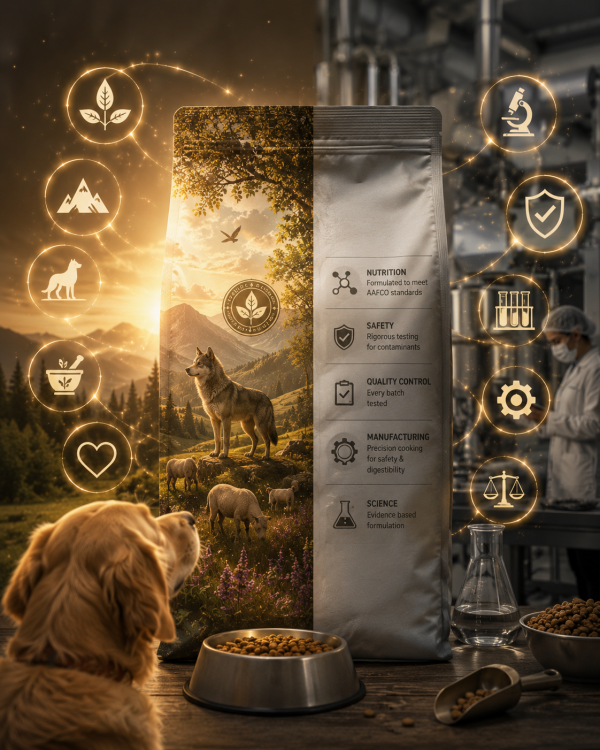
Photo by ChatGBT
Reality Check in the Pet Food Aisle
For pet parents, it’s important to look at claims through a skeptical lens. Some are much stronger than the stuff inside the packaging, and nobody wants to pay a premium for a product that’s more performative than it is impactful.
Marketing claims often attempt to simplify a complex science, but nutrition and safety are far more meaningful indicators of a pet food’s value than any buzzwords printed on the front of a bag. But much like in a game of telephone, they tend to take on lives of their own when consumers are presented with them without adequate explanation, clarification, or guidance.
While many are well-intentioned, not all are so innocent. Some of these claims and the way they’re being marketed are directly playing on consumers’ fear and guilt, two powerful emotions that subconsciously dictate our spending.
Brands will continue to pretend that claims such as “clean-label,” “minimally processed,” and “holistic” are based on defined standards or science, but really, their only basis is getting people to spend more money because they’d feel bad otherwise. They may symbolically stand for something or make us feel better about what we feed our pets, but otherwise, they’re pretty arbitrary.
Regardless, consumers are tired of this vicious game.
If you’re a brand, think of it this way: if you can’t prove the claim, pick another lane. Pet parents are savvier than ever, and the rise of wearable technology is providing insight into pet health, behavior, and wellness that may actually prove a diet or supplement isn’t following through on its claims. Protect your brand’s reputation with integrity instead of bolstering it with buzzwords. BSM Partners’ expert team offers 500+ years of cumulative experience to help you crack the claims code without crumbling consumer trust in the process.
If you’re a pet owner (which many brand owners also are!), don’t believe everything you read. Equip yourself with basic knowledge about pet nutrition science by tuning in to the Barking Mad podcast and asking critical questions of brands and the marketing claims they use.
Follow us on LinkedIn for the latest updates on all things happening here at BSM Partners.
About the Author
Jordan Tyler is the Director of Media at BSM Partners and co-host of the Barking Mad podcast. She has more than seven years of experience reporting on trends, best practices and developments in the North American pet nutrition industry. Jordan resides in Bentonville, Arkansas, with her husband and their three furry family members.
This content is the property of BSM Partners. Reproduction or retransmission or repurposing of any portion of this content is expressly prohibited without the approval of BSM Partners and is governed by the terms and conditions explained here.