We Need More Balanced Treats and Toppers!
Complete and balanced diets meet all nutrient requirements as indicated by AAFCO. These minimum and maximum nutrient requirements have been determined and refined over the years based on various studies in companion animal nutrition. These studies have helped us gain an understanding of what happens when certain concentrations of nutrients are not found in the diet or what happens when they are in excess. A lack of a balanced diet can lead to a variety of issues which include, among other things, the bones and joints, skin and coat, immune system, neurologic system, cardiovascular system, and dental disease. While pet food companies have done a great job of creating these balanced diets for our pets, they have not done a great job of creating balanced compliments to the diets such as treats and toppers. The issue is compounded by overfeeding of these add-ins as a result of unknowing owners or poor feeding guidelines on the package which leads to an overall diet lacking in essential nutrients.
We can use an example of a made-up topper to demonstrate this issue. Below are two topper formulations that have the same main ingredients, but one topper is balanced with vitamins, minerals, and fatty acids, and the other is not.
|
Chicken Stew Topper Complete and Balanced per AAFCO Guidelines for the Maintenance of Adult Dogs) |
Chicken Stew Topper Not Complete and Balanced per AAFCO Guidelines
|
|
Ingredients |
Ingredients |
|
Chicken broth, chicken, sweet potato, tapioca starch, sunflower oil, calcium carbonate, salt, potassium chloride, dog vitamin blend, magnesium proteinate, mineral blend, choline chloride, taurine, zinc proteinate |
Chicken broth, chicken, sweet potato, tapioca starch
|
|
|
Complete and Balanced Topper |
Not Complete and Balanced Topper |
|
Crude Protein (min) |
8.5% |
8.5% |
|
Crude Fat (min) |
2.0% |
2.0% |
|
Crude Fiber (max) |
1.5% |
1.5% |
|
Moisture (max) |
78.0% |
78.0% |
Using these chicken stew toppers as an example in varying amounts, the chart below demonstrates the effect of feeding unbalanced treats and toppers.
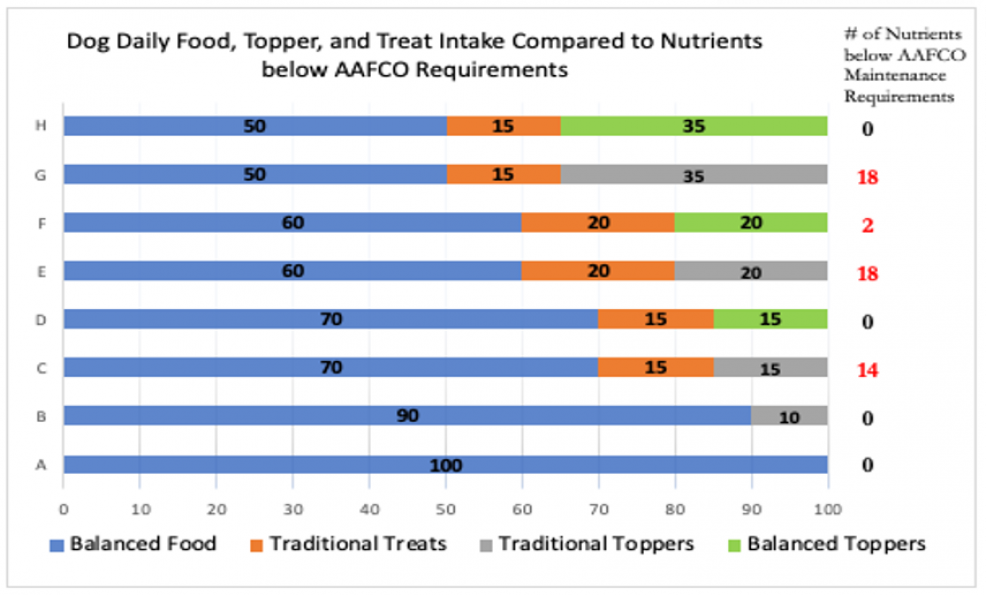
Each bar’s number represents the percentage of the total diet’s calories from either their balanced diet, unbalanced treat or topper, or balanced topper. The nutrients that did not meet minimum requirements based on how the dog was fed are on the right-hand side. The typical rule of thumb is that you can feed 10% of the total diet as unbalanced treats, toppers, or table foods without issue. This is true in this case as well and is demonstrated in row B where there are no nutrient deficiencies. However, most owners do not only give 10% of the diet as a topper with no treats. Instead, they may feed 10% as a topper, 10% as a biscuit-type treat, and then throw in a dental treat which could easily be 10% of their daily calories. It’s easy to see that if owners feed unbalanced treats with an unbalanced topper as well as treats, there are many nutrient deficiencies. Simply switching out an unbalanced topper with a balanced topper helps to keep the total diet balanced and avoid nutrient deficiencies.
Given this information, it’s hard to understand why there are not more balanced options out there. One reasonable option for owners is to feed a canned diet as a topper or a balanced home-made style diet as a topper. However, many companies avoid the creation of a balanced topper or treat since they are concerned about cost or manufacturing challenges. However, the truth is that if the treat or topper is balanced then the feeding guidelines can be much more generous offering an improved likelihood of increased sales and overall revenue. The chart below shows the minimal cost difference between the creation of this unbalanced versus balanced topper.
|
|
Complete and Balanced Topper |
Not Complete and Balanced Topper |
|
Formula Cost ($/ton) |
1331.63 |
1321.01 |
|
Formula Cost ($/lb) |
0.67 |
0.66 |
|
Formula Cost ($/12.05oz) |
0.85 |
0.85 |
If despite this knowledge an unbalanced treat or topper is still desired companies should consider more stringent feeding guidelines which allow for the feeding of 5% of the diet as the treat or topper rather than 10%. This will allow the owner to mix and match more unbalanced additions into the diet with less risk to the pet. The health of the pets we serve is of the utmost importance. Improvement in nutrition with complete and balanced add-ins is easy to see and understand. If companies wish to make a huge improvement in nutrition with their treats or toppers, they don’t have to find the most expensive, newest, most unresearched, novel, superfood ingredients, but instead, look to the creation of balanced treats and toppers.
Follow us on LinkedIn for the latest updates on all things happening here at BSM Partners.
About the Author
Renee Streeter is a Doctor of Veterinary Medicine and a Diplomate of the American College of Veterinary Internal Medicine (Nutrition). She obtained her Bachelor's degree in Animal Science from Cornell University and served as a farm animal nutritionist for a major feed company before attending veterinary school at Ross University. Her clinical rotations were done at Cornell University’s college of veterinary medicine, where she stayed on to do her Clinical Nutrition residency. While working in a large general practice and doing clinical nutrition consultation, Dr. Streeter also founded her own veterinary nutrition consulting company and currently helps industry clients through her position as the Nutrition Practice Principal at BSM Partners.
This content is the property of BSM Partners. Reproduction or retransmission or repurposing of any portion of this content is expressly prohibited without the approval of BSM Partners and is governed by the terms and conditions explained here.