The Wasted Food Scale: Enlightening or Depressing?
Stewardship of food resources is a topic that many pet food consumers and even pet food companies don’t think enough about. The agricultural economy has a finite capacity to produce both animal- and plant-based food ingredients, not only for our human population but also for our pets and livestock. The pet food industry alone uses millions of tons of both animal and plant based ingredients. Much of this is in the form of upcycled ingredients that otherwise are not used in the human food sector. Up until recently with an EPA recognition change, many upcycled ingredients commonly used in pet food are now recognized as one of the largest scale ways to measure how food waste can be diverted into something utilized and not lost.
It is estimated that, in the US alone, up to 24% of all usable food for humans and animals ends up in landfills, according to the 2023 EPA-sponsored Field to Bin report. From that same report, a new way to view and understand how food waste can be reduced was developed and named the Wasted Food Scale. This concept replaced the EPA’s Food Recovery Heirarchy, which was developed in the 1990s. However, the Wasted Food Scale better reflects the advancements in minimizing food waste through different combinations of practices and outlets beyond primary consumption.
In order of environmental and economic preference, these practices include:
- Most preferable: Prevention by producing and consuming only what is needed
- Donation and upcycling of unused food
- Using surplus food to feed animals
- Not harvesting excess crops
- Composting, which includes application to land for soil fertilization
- Least preferable: Sending surplus food to landfills or incineration.
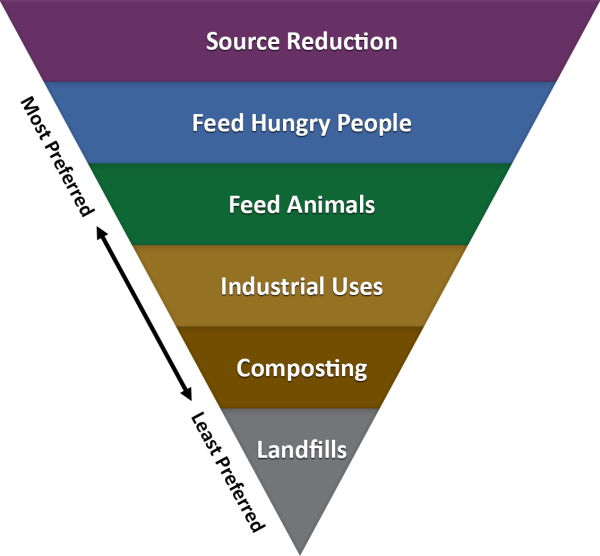
Graphic by the California Department of Food and Agriculture
Wasted food isn’t just an ethical and environmental problem; it's also an economic problem for everyone. In the US alone, over $700 per person is wasted every year on food that could be consumed by people or animals.Given the current US population of approximately 340 million people, that amounts to almost $240 billion in lost consumer spending.
There are many challenges to reducing food waste, many of which relate to a lack of economic incentives for both private companies and individuals. Some traditional food waste may represent potential pet food ingredients that can help take the pressure off ingredients used in both human and pet food. However regulatory barriers, potential liability and even consumer perception may prevent otherwise usable food waste from being efficiently used in pet food production.
Legislation has been discussed and proposed to standardize best-by or food date labeling to allow food to be donated or used, depending on the product format and its life cycle. Liability limitations and tax deductions for companies that donate food can also help reduce food waste. Some states and local municipalities have passed legislation to divert food waste from landfills; however, enforcement is challenging, and compliance can be difficult. As long as food waste is an accepted part of our lives and culture, the expectation for change is challenging at best.
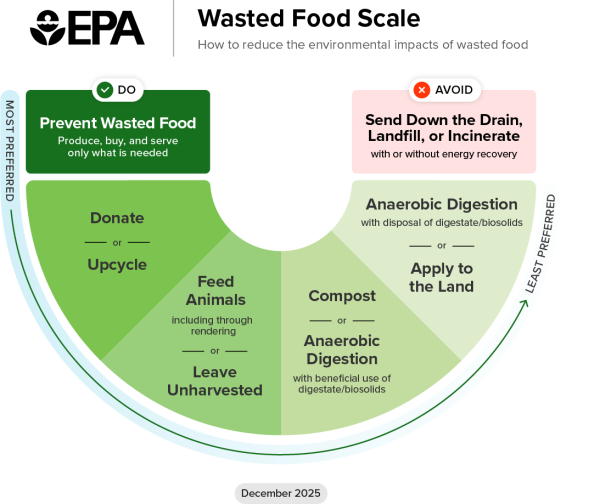
Graphic by the Environmental Protection Agency
Feeding food waste to livestock can also be practiced, provided it complies with the Food Safety Modernization Act (FSMA). When the Wasted Food Scale was introduced in 2023, it curiously lacked a metric to classify rendered animal-source ingredients in the “Feed Animals” section of the scale. Rendering refers to the process where portions of livestock that aren’t typically used in the human food supply chain such as internal organs and meat trimmings are cooked and refined into protein and fat-based ingredients that can be used in pet food, biofuels, and fertilizer, to name some examples. Already today, a significant amount of food waste that would otherwise be sent to the landfill is diverted for pet food use. It is unknown why rendering was initially left off the Wasted Food Scale, as this process is significant, preventing approximately 16 million tons of animal-based ingredient waste from entering landfills annually in the US and Canada alone.
Beginning in late 2024, a bipartisan group of 28 members of Congress began contacting the EPA, asking them to consider including rendering as a factor in the Wasted Food Scale program. A bipartisan group of six senators also led support for the same cause. By 2025, the current administration’s EPA administrator agreed that by not including rendering in the “Feed Animals” part of the scale, we would exclude one of the largest scale outlets to upcycle potential food waste into usable ingredients and other commodities, and it officially became part of the overall strategy to utilize food waste in ways that avoid landfills.
As scientists, researchers, consumers, and stewards of our resources, we all owe it to ourselves and our neighbors to try to mitigate food waste for ethical, environmental, and economic reasons. This includes calling for private industry incentives for new, novel, and effective approaches to achieving waste-reduction goals. As an example, pet food industry professionals such as formulators, nutritionists and regulatory experts can help educate pet food consumers on the importance of utilizing upcycled food waste into nutritious pet food ingredients. In addition, our elected officials should push for legislation that also promotes waste reduction, and all constituents who are educated about and believe in food conservation should support efforts to help mitigate waste and conserve our food resources.
Follow us on LinkedIn for the latest updates on all things happening here at BSM Partners.
About the Author
Dr. Bradley Quest, DVM, is the Principal Veterinarian at BSM Partners. Dr. Quest is a leading innovator in the pet dental health products, having several decades of experience formulating in this category. He has practiced clinical veterinary medicine, developed and tested hundreds of pet food and health products, performs extensive animal health research, and helps navigate pet food ingredient approval for clients.
This content is the property of BSM Partners. Reproduction or retransmission or repurposing of any portion of this content is expressly prohibited without the approval of BSM Partners and is governed by the terms and conditions explained here.