Report: Pet Food Surges Ahead While Feed Markets Face Constraints
Between rising geopolitical tensions, economic stressors, sustainability regulations, and animal disease risks, the global animal feed market didn’t exactly have an easy run in 2025.
Avian influenza (including H5N1), African swine fever (ASF), and the New World screwworm disrupted agricultural supply chains in their own right, all while war, climate instability, and tariff negotiations loomed large over crop yields and margins.
According to Alltech’s 2026 Agri-Food Outlook, more than 80% of global survey respondents admitted they felt, “at least some impact from geopolitical tensions and events” in 2025. Nearly one-third (29%) of respondents said production costs (including labor, energy, and raw material costs) were “one of their top challenges.”
Extreme weather is increasingly impacting this sector, but those impacts are felt at different intensities from region to region. In Asia, 12% of respondents cited extreme climate patterns as “one of the greatest challenges to feed production,” compared to just 7% in Africa, 2% in Europe and Latin America, and less than 1% in the Middle East, North America, and Oceania.
However, climate concern was not always equivalent to the consequences recorded. For example, Alltech shared Ecuador’s corn harvest dropped by as much as 29% in 2025, due to severe weather pattern shifts, impacting both poultry and pig production in the country, yet only 2% of Latin American respondents viewed climate as a significant business risk.
This goes to show that perception and reality aren’t always aligned, and in tightly linked supply chains, the consequences are rarely constrained to their original borders.

Photo by FabrikaPhoto
Food for Pets
These were just a few headwinds faced by the global animal feed industry last year, and pet food production was no exception.
Comparing pet food production to feed for broiler chickens seems a little odd, particularly when canine and feline companions are seen more as furry family members than property or assets across the world—not just in the United States. From Africa to Asia to Europe and Latin America, rising rates of pet ownership, urbanization, humanization, and premiumization are driving increased demand for commercial pet food, even in markets where feeding table scraps remained the norm well into the 21st Century.
This was true of China, Africa, the Philippines, India, Australia, and certain European markets such as Germany, Poland, Spain, and Turkey, according to Alltech. Meanwhile in Latin America, geopolitical and economic pressures resulted in a split economy: Those who could still afford to adopt commercial pet nutrition continued to do so, while those hit hardest by inflation and income constraints traded down.
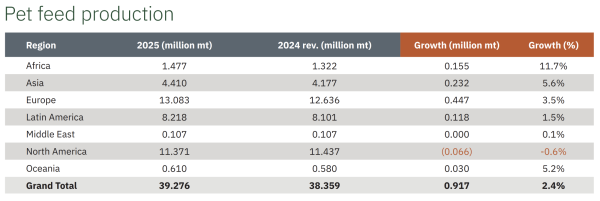
Overall, global pet food tonnage grew 2.4% in 2025 to roughly 39.28 million tonnes (metric tons). While North America, the Middle East, and Latin America saw relatively flat production from 2024 to 2025, Europe, Oceania, Asia, and Africa saw notable growth, with Alltech citing modern pet ownership trends as the main catalyst.
This modest growth represents a slowdown from previous year-over-year comparisons shared by Alltech, to which the firm attributed primarily to “normalization in North America following pandemic-driven expansion, alongside demographic shifts in pet ownership.”
In other words: The United States has been on the cutting-edge of pet food for decades, to the point where the market has matured and become, at times, oversaturated. This in part laid the groundwork for the rest of the world’s pet food market development, opening the door for countries like Europe, Asia, Oceania, and Africa to lean harder into domestic production.
Yet, while North America seems to lead most pet food trends, Europe actually produced more pet food by volume in 2025 (11.38 million tonnes and 13.08 million tonnes, respectively). Alltech clocked increased pet ownership and pet spending rates in Germany and Spain, while Poland and Turkey have established themselves as key global and regional distribution hubs for pet food. This market is quickly evolving and, while behind on certain trends currently influencing the American market, is certainly catching up.
Finally, Africa saw the highest year-over-year pet food production rates in 2025, going from 1.32 million tonnes in 2024 to 1.48 million tonnes in 2025, representing growth of 11.7%. Rising pet ownership and manufacturing expansion in South Africa were primary drivers, according to Alltech. Africa only makes up 3.75% of global pet food production, but this growth does indicate rapidly shifting pet feeding patterns in markets where table scraps used to suffice.
Source Alltech Agri-Food Outlook 2026
The Bigger Bowl
As the world continues to turn, the challenges faced by this sector in 2025 will continue to impact it this year and beyond. Regardless of whether they intensify or diminish, supply chain disruptions and geopolitical tensions will continue to challenge feed producers around the world.
Where the global animal feed market used to be a story about volume, the narrative has shifted to resilience and diversification. Those equipped to absorb the next disruption, adapt to that change, and deliver despite uncertainty will be winners in 2026.
Understanding trends and challenges at the production level provides critical context, sure. But it also provides strategic intelligence. For anyone in the pet food and animal nutrition space, staying ahead of the curve rather than reacting to it is where real competitive advantage emerges.
BSM Partners tracks these complex dynamics, so you don’t have to. Reach out today to learn how our experts can support your strategy to success.
Follow us on LinkedIn for the latest updates on all things happening here at BSM Partners.
About the Author
Jordan Tyler is the Director of Media at BSM Partners and co-host of the Barking Mad podcast. She has more than seven years of experience reporting on trends, best practices and developments in the North American pet nutrition industry. Jordan resides in Bentonville, Arkansas, with her husband and their three furry family members.
This content is the property of BSM Partners. Reproduction or retransmission or repurposing of any portion of this content is expressly prohibited without the approval of BSM Partners and is governed by the terms and conditions explained here.