Processing Isn’t the Problem: A Closer Look at Extruded Pet Food
As the pet food space continues to diversify, conversations around processing have become increasingly prominent. Extruded kibble, in particular, is often compared to emerging formats in the pet space like fresh, gently cooked, or raw pet diets or ultra-processed foods in the human space. While these comparisons are common, they are not always grounded in a clear understanding of how each product is actually made.
Extrusion is one of the most widely used and well-established manufacturing methods in pet food (and in human food!). Over the past decades, it has been refined to deliver safe, nutritionally complete, and shelf-stable products at scale; however, it is also frequently described using broad terms like “ultra-processed,” which can oversimplify the role processing plays in pet nutrition.
Recent industry conversations have further highlighted how research findings and media coverage can sometimes blur the line between product format and product quality. In some cases, conclusions are drawn that imply one format is inherently superior to another without fully accounting for differences in formulation, study design, or controlled variables. This reinforces the importance of evaluating pet food through a scientific and process-based lens rather than relying on generalized claims.
To meaningfully evaluate extruded pet food, it is important to understand what extrusion is, what it does, and why it is used.
What Is Extruded Pet Food?
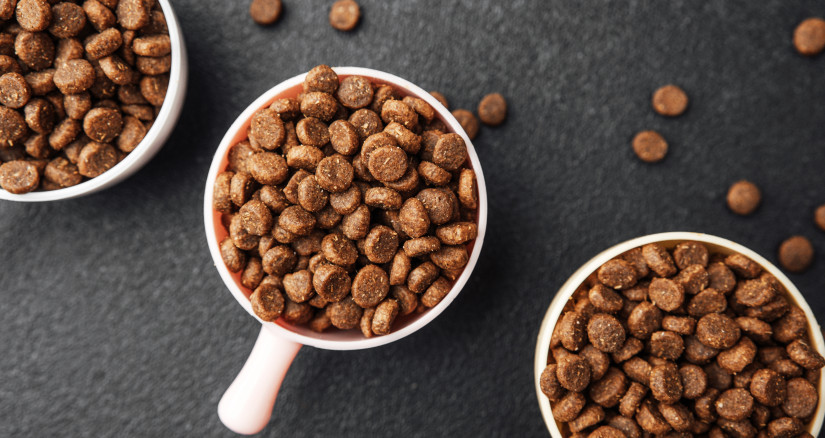
Extruded pet food is a dry, shelf-stable product created through a combination of grinding, mixing, cooking, shaping, and drying. This process uses controlled heat, moisture, and pressure to transform raw ingredients into a finished kibble.
Key characteristics of extruded pet food include:
- Low moisture content supports extended shelf life without refrigeration
- Consistent nutrient delivery through controlled formulation and processing
- High scalability and manufacturing efficiency
- Flexibility in shape, size, and texture
Importantly, extrusion is not just about forming kibble—it is a transformational cooking process that impacts food safety, digestibility, and nutrient availability.
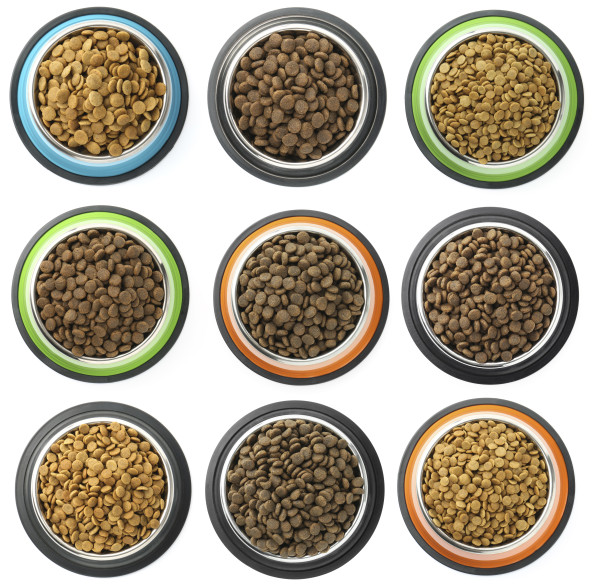
Photo by africaimages
Why Processing Matters in Extruded Pet Food
As with fresh or other pet food formats, processing serves several essential functions:
- Food safety: Leveraging processing temperatures and pressures to help reduce microbial risks and improve product safety
- Nutritional reliability: Enhancing nutrient digestibility and bioavailability through controlled processes like grinding, cooking, and reducing antinutritional compounds
- Palatability: Enhancing texture, aroma, and flavor to encourage excitement at mealtime
- Convenience: Utilizing packaging, portioning, storage, and serving formats that make feeding more convenient for pet owners
Processing is sometimes framed as something to be minimized; however, it is a critical tool used to make pet food both safe and nutritionally effective.
Extruded Pet Food Manufacturing: Step-by-Step
- Dry ingredients are ground, sieved as needed, and blended (“dry blend”).
- The dry blend is combined with wet ingredients, water, and steam in a preconditioner to form a dough and initiate cooking.
- The dough moves into the extruder, where it is cooked under heat and pressure.
- The cooked dough is forced through a die plate of a specific shape and then cut to the desired kibble size by a rotary cutter.
- The freshly cut kibbles are dried to reduce moisture and then cooled within 10°F of the ambient temperature.
- If any palatability enhancers (palatants) or heat-sensitive ingredients (enzymes, probiotics, sodium hexametaphosphate, etc.) are to be added, the cooled kibbles enter a rotating drum to be coated.
- The finished kibbles are weighed into packages, sealed for protection, and boxed or palletized for distribution.
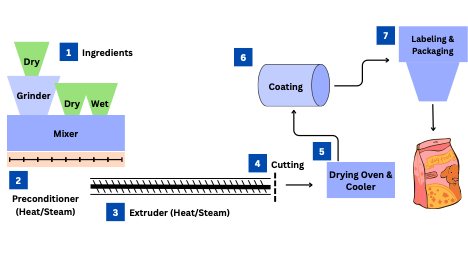
Photo by BSM Partners. Figure 1. Extruded Pet Food Manufacturing Process
Understanding Common Perceptions Around Extrusion
Extruded pet food is sometimes characterized as being heavily processed in a way that diminishes nutritional quality; however, this perspective often overlooks both the purpose and the control of the extrusion process.
- Heat treatment is used intentionally to improve safety and digestibility.
- Nutrient changes during processing are anticipated and addressed through formulation strategies.
- Functional ingredients can be applied after cooking to preserve activity if necessary.
It is important to recognize that product format alone does not determine nutritional outcomes. Comparisons between formats, such as extruded versus fresh, can become misleading when they do not account for differences in formulation, nutrient targets, or study methodology.
Recent discussions in the industry have shown how easily conclusions can be overstated when research is interpreted without full context. Outcomes observed in a specific study design may be attributed to “processing level,” when in reality, they may reflect differences in ingredients, nutrient composition, or overall formulation approach. This highlights how quickly complex systems are reduced to overly simplistic narratives, reinforcing the need for more rigorous evaluation of the evidence.
Similarly, while fresh pet food is often positioned as “less processed,” it still relies on thermal steps to ensure safety and stability. The key distinction across all product formats is not the presence or absence of processing, but how that processing is applied to the matrix of each formula specifically. A meaningful comparison between products requires looking beyond format and considering the full system: formulation, ingredient selection/source, processing, and quality control.
Extrusion remains a cornerstone of the pet food industry because it is a highly controlled, efficient, and scientifically grounded process. When properly executed, it can produce complete and balanced diets that meet the nutritional needs of pets while supporting safety and convenience for pet owners.
As conversations around pet food continue to evolve, it is important to move beyond simplified narratives about processing and instead focus on the science behind how products are formulated and manufactured.
BSM Partners works with pet food companies across all formats to support informed decision-making at every stage of development, from ingredient sourcing and supplier verification to formulation, process validation, and food safety program development.
In an environment where research findings and media narratives can sometimes oversimplify complex topics or lead to misleading conclusions, we help brands critically evaluate the evidence and focus on what the data actually supports. This enables decisions that are not only scientifically sound and compliant but also strategically aligned with product performance and consumer expectations.
Follow us on LinkedIn for the latest updates on all things happening here at BSM Partners.
About the Author
Ada-Miette Thomas Holyfield is a senior analyst at BSM Partners. She received both bachelor’s and master’s degrees in food science with an emphasis on nutrition. Ada-Miette conducted research with a focus on human nutrition and studied the effects of carbohydrate sources on markers of Metabolic Syndrome in adults.
This content is the property of BSM Partners. Reproduction or retransmission or repurposing of any portion of this content is expressly prohibited without the approval of BSM Partners and is governed by the terms and conditions explained here.