
From Paws on the Grass to Paws on the Hardwood: A Dog’s Perspective
Editor’s note: This article is the third installment in our fostering series. In Parts One and Two, we explore the science behind why fostered dogs are significantly more likely to be adopted, how foster homes help dogs overcome the physiological and behavioral impacts of shelter stress, consumer perceptions of fostering, the volunteer math behind successful placements, and why every goodbye is ultimately a success story.
After exploring the science behind fostering and the transformative impact foster homes have on adoption outcomes in the first two articles of this series, it is worth considering what that transition might feel like from the dog's perspective. My experience fostering dozens of dogs—many of whom being hunting and outdoor dogs who are experiencing life inside a home for the very first time—reveal the challenges, confusion, and, ultimately, remarkable adaptability that accompany these transitions.
To illustrate those lessons, this installment tells the story through the eyes of a foster dog learning to navigate a completely new world. While the perspective may be playful, the experiences are rooted in real observations from dogs learning to navigate indoor life, new routines, unfamiliar sounds, and the process of becoming family pets.
Change Management: A Dog’s Perspective
A few months ago, I underwent a radical corporate restructuring. I left my long-standing position as Outdoor CEO, where I managed a 10,000-square-foot open-air facility, oversaw Squirrel Relations, and ran a highly aggressive Perimeter Security team, to take over as Indoor CEO of a high-density, carpeted headquarters.
Going from a world where my only boundaries were fences to an environment governed by strict "house rules" was a massive cultural shock.
For any leaders currently navigating a major career pivot, adapting to a hyper-stimulating new workplace, or managing demanding new stakeholders, here is my raw, unfiltered journey of navigating the transition.
Navigating the Sensory Overload (The Onboarding Phase)
Outdoors, I relied on macro-trends: wind direction, the scent of incoming rain, and distant neighborhood acoustics. Moving indoors felt like dropping into a trading floor at peak hour. The sensory data were overwhelming.

Photo by vadymvdrobot
The Hardwood Corridor Friction
Talk about a steep learning curve. Transitioning from high-traction grass to low-friction polished wood required a total overhaul of my stability control. My initial attempts to sprint into meetings resulted in a less-than-graceful drift directly into the recycling bin.
Lesson learned: Slow down your approach when entering unfamiliar territory. Too often, whether we're starting a new role, joining a new team, or navigating a major life change, we assume the same skills and habits that worked in one environment will immediately transfer to another. Sometimes, success requires recalibration before acceleration. Taking time to observe, learn the terrain, and adjust your footing can prevent unnecessary stumbles.
The Acoustic Volatility
The indoor office has some terrifying tech. The whirring dishwasher, a moisture-heavy, vibrating floor-beast, initially looked like a Class-A disruption. And when the humans blasted loud music, the bass frequencies rattled my ribcage. I had to learn to build resilience, or at least strategically pivot to the quiet boardroom (the space underneath the dining room table).
The reality is that many of the things that seem threatening during a transition are simply unfamiliar. New environments come with new sounds, expectations, personalities, and routines. Not every disruption requires a reaction. Sometimes the best strategy is to find a place to regroup, give yourself time to process, and distinguish between genuine threats and temporary discomfort.
The Luxury Upgrade
It wasn't all friction. Trading the damp lawn for the ergonomics of a memory-foam plush bed and the sheer executive privilege of the "human couch" completely optimized my workflow.
That's another lesson many of us miss during periods of change: We become so focused on what we've lost that we overlook what we've gained. Every transition comes with tradeoffs, but it also creates opportunities that didn't exist before. The challenge is learning to recognize and appreciate the benefits of the new environment.
Overcoming the Bottlenecks: Potty Training & The Big TV
Every new role comes with steep KPIs. For me, the compliance department introduced a zero-tolerance policy on what they called "accidents."

Photo by YuriArcursPeopleimages
The Potty-Training Pivot
Outdoors, the entire world was my whiteboard; I executed a "brain dump" wherever inspiration struck. Indoors, I quickly discovered that using the Persian rug for data entry was a massive breach of company policy.
To solve this, I had to develop a seamless, real-time communication strategy. I trained my stakeholders to recognize a specific, high-priority notification: standing completely frozen by the back door while emitting a low, pathetic whine. Aside from a single system crash during a severe thunderstorm, pipeline efficiency is now at 98%.
Confronting Simulated Realities (The Big TV)
In my second week, a giant, glowing rectangle on the wall suddenly materialized a rival pack of wolves. I initiated a maximum vocal override and deployed defensive barking.
It took a few days of data collection to realize these entities lacked an olfactory profile; they had no scent. They were holograms. Realizing what is a real threat versus what is just corporate noise was a massive breakthrough for my mental bandwidth.
Cross-Functional Mergers: Managing the Stakeholders
A new CEO is only as good as their team alignment. My new indoor portfolio required managing an incredibly diverse, multi-tiered corporate hierarchy:
|
Stakeholder Group |
Initial Assessment |
Strategic Approach |
Current Status |
|
The Parents (The Venture Capitalists / Founders) |
High scrutiny, control the budget (kibble), and set operational boundaries. |
Strict compliance, strategic tail-wagging, and deep emotional labor. |
Fully Aligned. Secured executive couch rights and premium treat distribution. |
|
The Children (Junior Associates) |
High-risk, erratic, loud audio spikes. |
Deployed the "Puppy Eyes" protocol. |
Strategic Partners. They are now my primary distributors of dropped cheese cubes and pizza crusts. |
|
The Cat (The Chairperson of the Board) |
Operates an autonomous shadow government. |
Signed a strict non-aggression pact. |
Armed Neutrality. She owns the high shelves; I own the floor. We ignore each other perfectly. |
Managing Up: Navigating ‘The Parents’
The hardest part of the merger was dealing with the Co-Founders (Mom and Dad). They hold the purse strings, control access to the door, and enforce the micro-management policies.
Initially, Dad was highly resistant to my "sleeping on the human bed" proposal, citing operational cleanliness. Meanwhile, Mom implemented a strict, metric-driven feeding schedule that completely ignored my requests for 24/7 snacking.
By leveraging deep emotional intelligence, specifically leaning my entire body weight against their shins while they drank their morning coffee, I successfully dissolved their corporate defenses. Dad now sneaks me scraps under the table when Mom isn't looking, and Mom has doubled my daily head-scratch allowance. Managing up is all about soft skills.
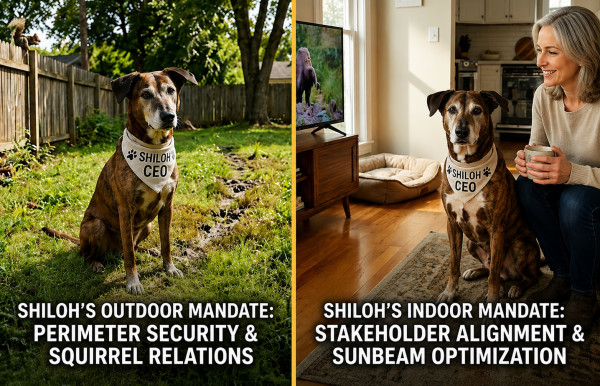
Photo by ChatGPT
The Takeaway: Finding Your Comfort in the New Role
Do I miss the raw freedom of the wild? The wind in my fur, the mud between my toes, and the unbridled joy of digging a hole to absolutely nowhere? Sometimes.
But true leadership is about adaptation. The climate control here is magnificent, the dividends in belly rubs are hitting record highs, and the company culture is incredibly supportive. I’m no longer just a wild dog; I’m a sophisticated, strategic corporate executive.
If you are facing a massive shift in your industry or role this quarter, embrace the discomfort. Recalibrate your traction, figure out who holds the snacks, and make peace with the founders and the cats in your office.
Now, if you'll excuse me, I have a mandatory 3-hour power nap scheduled in an exclusive sunbeam on the living room floor.
Follow us on LinkedIn for the latest updates on all things happening here at BSM Partners.
About the Author
Lee Ann Hagerty is Director of Customer Enrichment and Consumer Insights on the BSM Product Innovation team with 29+ years in the pet food industry, working for Iams/Eukanuba, Procter & Gamble, and Mars Pet Care. She brings a unique combination of project management skills with consumer insights, product design, animal nutrition, and sensory science which drives an in-depth understanding of the pet and consumer. Lee Ann has a passion for helping dogs. Over the last year and a half, she has fostered over 22 dogs. Many of them were senior dogs who had lived their entire lives outside as hunting dogs. She has been a foster pet parent for many years, and it brings her great joy to see these pets find fur-ever homes where they live with families indoors with love and care.
This content is the property of BSM Partners. Reproduction or retransmission or repurposing of any portion of this content is expressly prohibited without the approval of BSM Partners and is governed by the terms and conditions explained here.