Are Some Pet Food Claims Even Substantiable?
Strong pet food claims are being used by pet food companies now more than ever. Strong claims can help give a competitive advantage when a pet parent is trying to make up their mind whether to buy brand A or brand B pet food. Sometimes it is hard for even those of us with decades of pet food industry experience to navigate what claims can legally be made and what claims cross those regulations or may actually be unsubstantiable.
There are different ways that pet food and pet supplements are regulated at both the state and federal levels, and it is important that pet food and supplement companies distinctly differentiate those claims that are allowable by regulatory agencies. Claims related to health, such as joint, skin and coat, digestive, and immune system, can be made provided that proper substantiation is conducted. This can be accomplished either by referencing existing published research or actually conducting research studies with the food or supplement to demonstrate that it indeed does support the claimed health benefits.
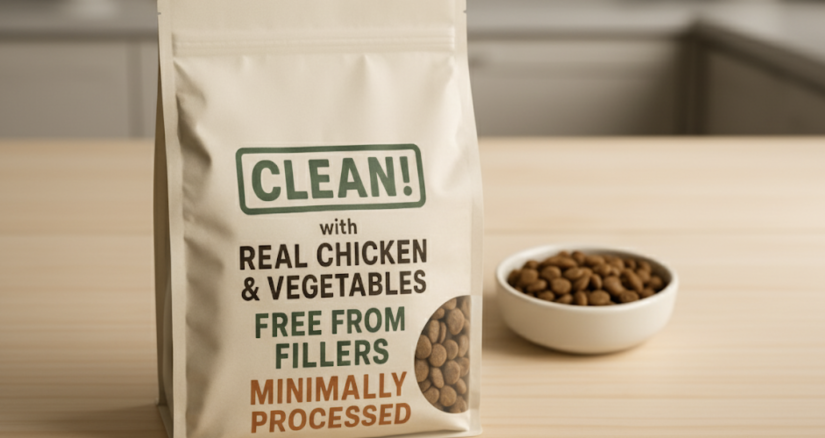
There are some claims on pet food that cannot be substantiated, or even allowed in some cases. One example would be to say a product has a “clean” ingredient listing on its label. A “clean” pet food label may sound appealing to a pet parent when the insinuated message by the pet food brand is that it refers to a product that only contains, for instance, natural ingredients. A pet food brand may also promote a “clean” label as not being made with synthetic preservatives, flavors, or colors. Sometimes products promoting their “clean” labels also promote “minimally processed” formulas. From a regulatory perspective, there is no way to substantiate either a “clean” or “minimally processed” claim. Therefore, neither are claims that pet food brands could actually prove if they were challenged on them by regulatory authorities.

Photo by rfaizal707
Processing itself refers to how a product is manufactured or made. All pet foods and supplements undergo some kind of process or manufacturing. There is no way to delineate, for instance, between different manufacturing processes for what would constitute “minimally” versus, say, “extensively” processed. It is much more important for the pet parent to know that the food or supplements they feed their pets are safe and undergo proper microbial risk mitigation steps, and that a manufacturer has a robust food safety plan to ensure that pets do not get sick, as has happened with the recent avian influenza outbreak.
Another ambiguous term some companies use is the word “filler.” This may be worded as “containing no fillers” or “not made with fillers” or something similar. This term is also not substantiable as there is no regulatory definition for the term “filler.” Some pet food companies suggest that a “filler” may be an ingredient that does not contribute to the nutritional value of the product. When doing an internet search, an AI bot describes a pet food ingredient “filler” as “an ingredient added to pet food primarily to provide bulk or dietary fiber without contributing significant nutritional value.” Examples given from the internet AI bot were: “corn, wheat and rice, which can help manage the caloric density of the food but may not offer essential nutrients.”
There are multiple problems with this AI-generated definition, which may likely be believed by many pet food consumers. Plant-based ingredients are used in almost all pet foods, and in most cases, they do provide essential nutrients. Plant-based ingredients, in many cases, provide complementary sources of protein and essential vitamins and minerals. Pet food provides nutrition, and almost all of the ingredients used in pet food help provide that nutrition. All animal nutritionists will agree that dietary fiber is necessary for healthy digestion in pets, and pet food should include some dietary fiber to support this. The bottom line is that using the word “filler” to describe pet food ingredients or to base a claim on has no regulatory or scientific substantiation.
Some pet foods claim to be “free from” a certain ingredient or class of ingredients. Some of those ingredients include corn, wheat, soy, chicken, and dairy, among others. This may be appealing to some pet parents who have pets that may have a food allergy or intolerance. However, for some pets, even trace amounts of an ingredient that would be unavoidable in usual manufacturing practices may cause a problem. Think about the disclaimer commonly seen on human food products that says, “manufactured in a facility that also contains peanuts.” This is important to people who have severe peanut allergies. Most pet food manufacturing lines make multiple types of formulas containing many different ingredients. It is much more acceptable (and accurate) to say “made without” than to say “free from,” because of how most pet food and supplement manufacturing facilities operate and to help mitigate regulatory scrutiny of this type of claim.
Photo by Fotoerfolg2022
There are also claims on pet foods that claim “longevity” or even “anti-aging.” These claims have been challenged by regulatory authorities, and the companies have been required to remove them. If companies are making these types of claims, they are rolling the proverbial dice with their brand. For example, a high-profile pet food company with actual research that may support their claims was forced to remove them several years ago. The lesson: it is always best to try to stay away from anything that claims it can help a pet live longer.
Of course, it is definitely not recommended to make any kind of pet food or pet supplement claims that specifically refer to treating, preventing or curing any disease process. This claim guidance has been thoroughly explained in a previous article by my colleage, Dr. Emily Taylor, MS, PhD, PAS, PCQI.
Pet food industry claims are like many other channels in that if something sounds too outlandish or too good to be true, it probably is. When pet parents see claims that they aren’t sure about, they should ask someone like their veterinarian for advice on choosing a pet food or supplement that may be best suited for their pet. Pet food and supplement companies owe it to their customers to promote substantiable, realistic claims and utilize expert consultants in product formulation, claims substantiation, and regulatory compliance, such as those at BSM Partners, to help them navigate the claims landscape.
Follow us on LinkedIn for the latest updates on all things happening here at BSM Partners.
About the Author
Dr. Bradley Quest, DVM, is the Principal Veterinarian at BSM Partners. Dr. Quest is a leading innovator in the pet dental health products, having several decades of experience formulating in this category. He has practiced clinical veterinary medicine, developed and tested hundreds of pet food and health products, performs extensive animal health research, and helps navigate pet food ingredient approval for clients.
This content is the property of BSM Partners. Reproduction or retransmission or repurposing of any portion of this content is expressly prohibited without the approval of BSM Partners and is governed by the terms and conditions explained here.