Are Slow Feeders, Snuffle Mats, and Puzzle Toys Worth the Hype? A Veterinary Perspective on Enrichment Feeding for Dogs and Cats
Walk into any pet store today and you’ll see an explosion of enrichment feeding tools, including slow-feeder bowls, snuffle mats, puzzle toys, and lick mats. They promise everything from reducing anxiety to improving digestion to “tiring your pet out.”
But I ask myself, as a pet parent and science nerd, do these tools actually work, and do pets really use them? I have always had my doubts, as they seem too simple to be of much value. Doesn’t stimulating my pet’s brain take a lot of work and interaction?
The answer is not necessarily. Let’s look at these devices and evaluate them based on science and behavioral biology.
Serving Pets’ Ancestral Instincts
From an evolutionary perspective, the traditional food bowl is the anomaly, not the enrichment toy. Wild canids and felids spend a significant portion of their day acquiring food. In fact, they may spend up to 30% to 60% of their time foraging or hunting rather than passively eating from a bowl.
Contrast that with the modern pet that gets meals predictably with minimal to no effort and little to no problem-solving required. This is a significant mismatch, and it matters. When natural behaviors like hunting, sniffing, and foraging are removed, animals often “fill the gap” with undesirable behaviors like overeating, anxiety, or destructiveness.
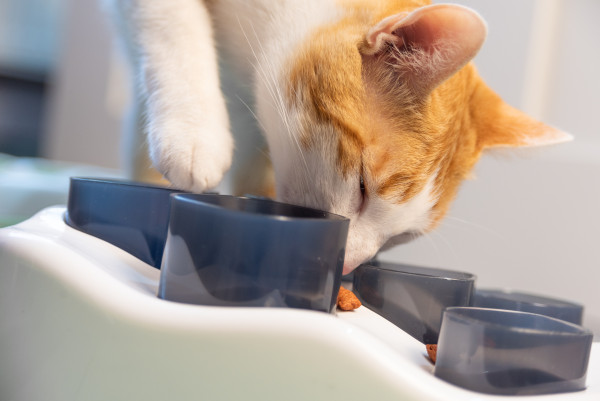
Photo by mary 8405
The Science of Enrichment Feeding
At its core, enrichment feeding is really about behavioral fulfillment, and slowing down eating is just a side benefit. What we’re trying to do is restore something that modern pet care has largely removed: the need to work for food. Research in both dogs and cats shows that feeding enrichment mimics natural hunting and foraging behaviors, increases activity and mental engagement, and reduces stress and unwanted behaviors.
Environmental enrichment as a formal concept emerged in zoological medicine and animal welfare science in the mid-20th century. Early zoo environments were heavily criticized for animals that were sedentary and commonly displayed stereotypic behaviors (pacing, overgrooming, repetitive behaviors). Researchers recognized the issue wasn’t just due to confinement but also to a lack of opportunities to engage in natural behaviors, especially feeding-related ones.
In the wild, animals engage in a complex sequence of behaviors that includes searching, problem-solving, manipulating their environment, and persisting through challenges to obtain a meal. Recognizing that traditional feeding methods in captivity failed to support these natural behaviors, zoos began to fundamentally change how food was delivered. Instead of presenting food passively, they introduced strategies such as hiding meat throughout enclosures, using puzzle boxes for primates and carnivores, scattering food to promote foraging, and offering frozen or suspended items that required additional time and effort to access.
The goal was simple but powerful: to make animals work for their food in ways that more closely resemble their natural behavioral patterns. The results of these changes were both compelling and consistent. Researchers saw reductions in stereotypic behaviors, increases in activity and engagement, and measurable improvements in overall welfare.
Do Pets Actually Like These Tools?
This is the question many pet parents (and veterinarians) quietly wonder. And one that has a really neat answer. The answer is yes. Across species, animals often show a phenomenon called contra-freeloading, defined as choosing to work for food even when identical food is freely accessible.
Studies and observational data show that animals spend more time foraging when puzzle feeders are introduced, engage voluntarily with enrichment devices, and continue to use them even when easier food options are available.
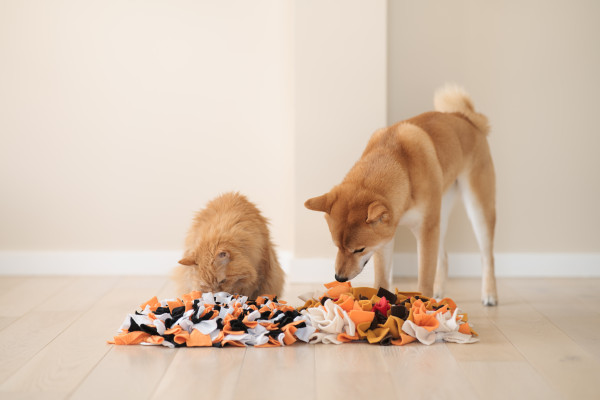
Photo by egrigorovich
Breaking Down the Tools
So, what are your options, and how can you use them to be most successful? Let’s look at some of the most common types of enrichment feeders available and how they may benefit pets. Many of these feeders were invented by zookeepers using common everyday household objects to create prototypes, and they work quite well. So, let your imagination go wild!
Slow Feeders
These feeders are designed to increase eating time by adding physical barriers. They work by reducing rapid ingestion and possible aerophagia (swallowing air). This may, in turn, reduce vomiting or regurgitation (we’re looking at those scarf-and-barf cats) and support satiety signaling by prolonging meal duration.
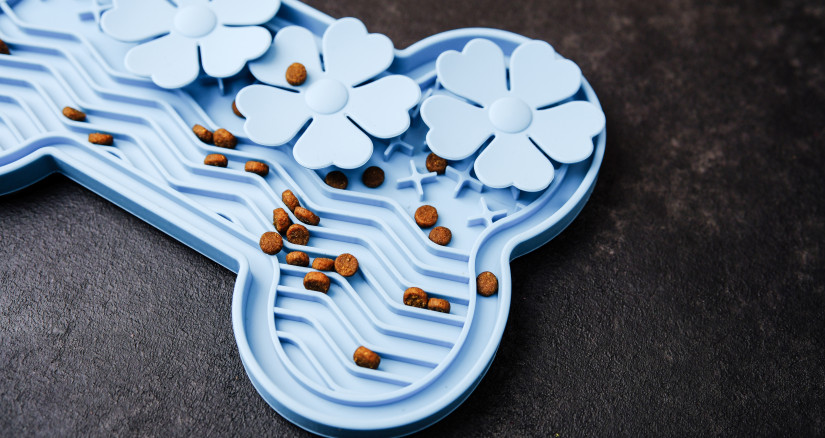
These come in many shapes and sizes, from something as simple as a metal ball that you add to your pet’s existing dish to beautiful porcelain dishes with ladybug and flower outcroppings to impede gulping.
Slow feeders are best for:
- Fast eaters
- Multi-pet households
- Dogs prone to gastrointestinal/gut (GI) upset
Puzzle Feeders
These feeders require pets to manipulate objects to access food. These types of feeders provide cognitive stimulation, increase physical activity, and support weight management. In fact, some studies have noted decreased aggression toward humans and other cats, reduced fear and anxiety, and, in some cases, the resolution of litter box avoidance.
These often range in difficulty, and the key to success is to start with something very easy and let your pet be successful and confident that they can get the food out before you gradually increase the difficulty of reaching it.
Puzzle feeders are best for:
- Obesity management
- Behavioral cases (boredom, anxiety)
- High-drive dogs
- Indoor cats
Snuffle Mats
These encourage olfactory foraging behavior. Olfactory enrichment, including sniffing activities, has been associated with reduced stress and improved welfare in dogs, and cats seem to enjoy these enrichment feeders as well. They are a great tool for activating scent-driven behaviors, promoting calm, focused engagement, and mimicking the natural food-seeking patterns of dogs and cats.
A small note: Do not leave the snuffle mat unsupervised, as it may become soaked with food fats and oils, which could make the mat itself more enticing to eat, posing a foreign-body risk for pets.
Snuffle mats are best for:
- Weight management
- Scent-driven breeds
- Pets that need gentle enrichment instead of high-arousal play
Lick Mats
It seems too simple to be true, but these deceptively simple feeders encourage repetitive licking, leveraging the natural, repetitive behaviors associated with parasympathetic activation and calming states. These are great for feeding diets that are in a high-moisture form, like canned or fresh foods, or for the occasional treat, try a little bit of peanut butter!
Lick mats are best for:
- Highly anxious pets
- Pets eating high-moisture foods
- Quick and simple introduction to enrichment feeders
When These Tools Don’t Work
Despite the benefits, enrichment tools are not universally successful. Common reasons for failure include difficulty, mismatch, and/or lack of proper introduction, pets with low food motivation, or, eventually, lack of novelty.
Like any behavioral intervention, success depends on individualization and appropriate use. If you're unsuccessful with one type of feeder, try another and keep trying until you find the kind your pets like. Even if they like the first one, try getting different types that provide other routes for enrichment by changing up the format with each feeding or by offering several types of feeders to reduce boredom with a single type.
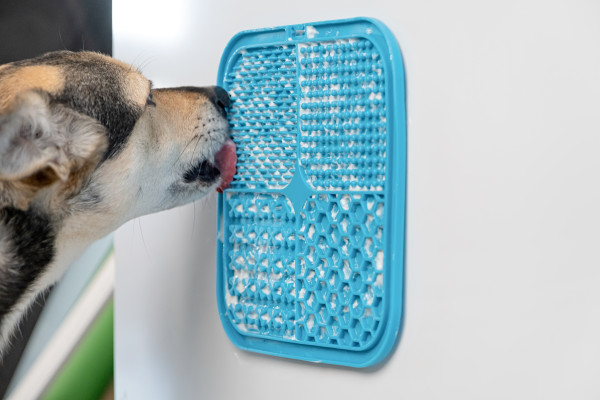
Photo by ilonadesperada
A Practical Veterinary Take
From a clinical perspective, enrichment feeding tools are not just “nice to have;” they can be vital therapeutic adjuncts. They are especially valuable in anxiety-related behaviors, obesity management, indoor cat enrichment, and high-energy dogs. But keep in mind they are not replacements for exercise, social interaction, or environmental complexity. Instead, they are one piece of a broader welfare strategy.
The Take-Home Message
Slow feeders, snuffle mats, puzzle toys, and lick mats may be trendy, but they are also grounded in a growing body of behavioral and welfare science that recognizes how dogs and cats are biologically wired to acquire food.
Research cited throughout this article consistently shows that when animals are given opportunities to engage in species-appropriate feeding behaviors, such as foraging, problem-solving, and manipulating their environment, it is beneficial. They demonstrate increased activity, improved mental engagement, and reductions in stress-related or undesirable behaviors. These tools transform feeding from a passive act into an interactive experience, supporting both physical health through slower intake and satiety signaling, and emotional well-being through activation of natural reward and coping pathways.
In many ways, enrichment feeding helps bridge the gap between the highly structured, convenience-driven lifestyles of modern pets and the behavioral demands shaped by their evolutionary history. And perhaps most importantly, it provides animals with something they inherently seek but are often denied in domestic environments: the opportunity to do something meaningful to obtain their food.
For many of our pets, the challenge is not simply what they eat; it is the absence of appropriate outlets for the way they are meant to live. Enrichment feeding offers a simple, evidence-based way to begin addressing that gap.
Follow us on LinkedIn for the latest updates on all things happening here at BSM Partners.
About the Author
Dr. Katy Miller works as the Director of Veterinary Services at BSM Partners. She earned her veterinary degree at Ross University and completed her clinical year at Louisiana State University. She previously served for 11 years as the Director of Dog and Cat Health and Nutrition for Mud Bay where she earned multiple certifications and specialized in pet food nutrition, prior to which she practiced general and emergency medicine for seven years. She is also a competitive three-day eventer, licensed falconer, and claims only two (Golden and Mini Doxie) of their nine dogs.
This content is the property of BSM Partners. Reproduction or retransmission or repurposing of any portion of this content is expressly prohibited without the approval of BSM Partners and is governed by the terms and conditions explained here.